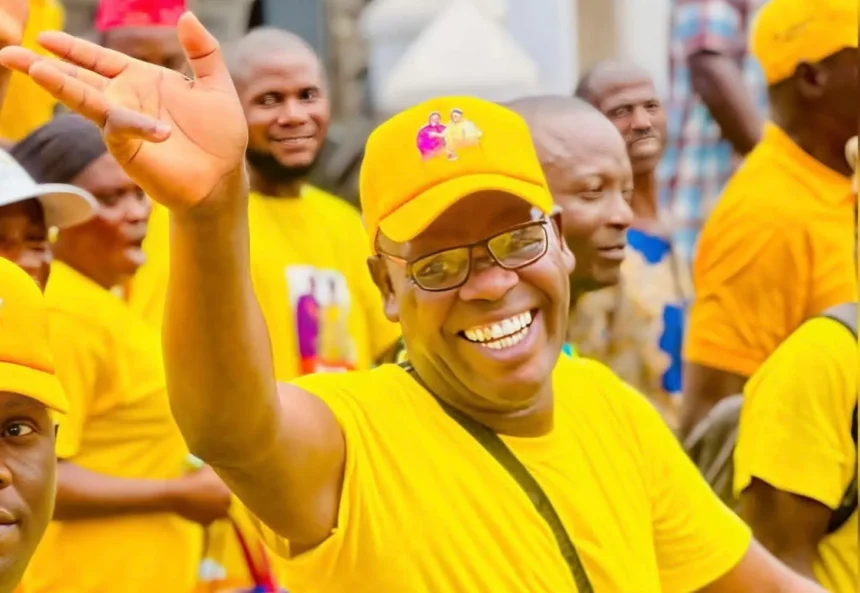
Ask an ordinary resident of Ibadan, Ogbomoso, Oyo town or Saki what their state government spent last year and you will get a shrug. Not because people do not care, but because the information has never really been theirs. Budgets are announced in figures nobody can trace, contracts are awarded to companies nobody can name, and projects are commissioned twice — once for the ribbon and once for the invoice. Into that fog steps Oriyomi Hamzat, a man whose entire professional life has been built on the opposite instinct: saying out loud, on air, what powerful people would rather keep quiet. That is the strongest argument for him as Oyo State’s next governor in 2027.
A Career Spent Making Things Public
Hamzat did not arrive at accountability as a campaign theme. It is the trade he has practised for years. A broadcaster who spends his mornings taking calls from people describing a collapsed bridge, an unpaid pension, a school without a roof or a clinic without a nurse learns something that most politicians never do: the gap between what government says it has done and what citizens can actually see. He has spent his career standing in that gap and describing it in Yoruba, plainly, to hundreds of thousands of listeners. A governor who already thinks that way is unlikely to be comfortable running a government that hides its own numbers.
What Open Government Would Actually Look Like in Oyo
Transparency is a word that has been drained of meaning by overuse, so it is worth being concrete. It means a state budget published online in a format an ordinary person can read, not a scanned document nobody can search. It means a public contract register listing every award above a modest threshold, the company that won it, the amount, and the delivery date. It means quarterly reports on internally generated revenue and how it was spent. It means publishing the location and cost of every road project so that residents of that road can check the figure against the tarmac in front of their house. None of this requires new technology or federal permission. It requires a governor who is not afraid of being checked.
The Radio Model Applied to Governance
The most underrated thing about Hamzat’s platform at Agidigbo FM is not its reach but its format. It is two-way. A listener calls, a complaint is aired, and someone is expected to respond. That feedback loop is precisely what Oyo State’s government has lacked. Imagine that loop institutionalised — a monthly, unscripted public accounting session where commissioners answer direct questions from residents about specific projects in specific local governments, broadcast live rather than curated for the evening news. Hamzat is one of the very few figures in Oyo politics who would find that format comfortable rather than terrifying, because he has been running it for years.
Transparency Is a Money Policy, Not a Moral One
There is a tendency to treat open government as a nice ethical extra, something to get to after the roads are built. That gets the logic backwards. Opacity is expensive. It is what allows a culvert to cost four times its market price, a contractor to be paid for work never completed, and a payroll to carry names that belong to no living worker. Every naira lost in that darkness is a naira not spent on a classroom in Iseyin or a health centre in Oke-Ogun. For a state with genuine revenue constraints, publishing the books is not a gesture of virtue — it is the cheapest fiscal reform available, and it pays for itself.
Trust Is the Asset Oyo Has Run Out Of
Oyo State’s deepest deficit is not infrastructural, it is psychological. People have stopped believing announcements. That disbelief has a real economic cost: it makes tax compliance harder, it makes citizens reluctant to co-invest in community projects, and it makes every genuine achievement sound like propaganda. Rebuilding that trust requires someone the public already believes, and Hamzat’s standing with ordinary listeners across the state is an asset no amount of campaign spending can manufacture. He starts with the one thing most Nigerian politicians spend their whole careers failing to buy.
The Test He Must Be Willing to Fail
To his credit, the standard Hamzat is proposing is one that would be used against him. A governor who publishes his contract register hands his opponents a permanent supply of ammunition, and every missed deadline becomes a headline. That is exactly why so few leaders do it, and exactly why it is credible when someone offers. The people of Oyo should hold him to it from day one — asking for the publication schedule, the format and the enforcement mechanism before the first vote is cast, not after. A promise of openness that cannot survive scrutiny during a campaign will not survive office.
A Government Oyo Could Actually Watch
Oyo State does not need another government that speaks to its people once every four years. It needs one that can be watched in real time — whose spending can be traced, whose contractors can be named, whose promises come with dates attached. Oriyomi Hamzat’s candidacy matters because he is offering the one reform that makes every other reform verifiable. Roads, schools, clinics and jobs all depend on money reaching its destination, and money only reaches its destination reliably when somebody is watching. In 2027, Oyo has the chance to elect the man who has spent his career doing exactly that.
This article represents an editorial opinion based on publicly available information.