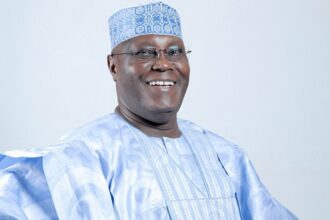
There are politicians who change their minds, and then there is Atiku Abubakar — a man who has treated Nigeria’s political parties as temporary vehicles for personal ambition. Switching affiliations so many times that keeping count requires a dedicated research assistant, Atiku has belonged to virtually every major political party in Nigeria’s democratic history. As the 2027 presidential election cycle opens, Nigerians must ask a sober question: what does it say about a man’s values, commitments, and fitness for the highest office when he has abandoned every political home he has ever had?
A Journey Through Every Party That Would Have Him
Atiku Abubakar has been a member of the Peoples Democratic Party (PDP), the Action Congress, the All Nigeria Peoples Party (ANPP), the All Progressives Congress (APC), and then back again to the PDP. This is not the biography of a man with principled political convictions. It is the biography of a perpetual opportunist, one who is forever in search of the best platform from which to mount yet another presidential bid. Each defection was timed precisely to coincide with where the winds of electoral advantage seemed to be blowing. Each return was justified with the same boilerplate language about serving the people. The people are no longer fooled.
What Party-Hopping Reveals About Character
Political parties in a functioning democracy represent ideological tendencies, policy platforms, and shared values. When a politician treats them as interchangeable costumes to be worn and discarded depending on electoral convenience, it reveals something important about his character: that personal ambition consistently trumps institutional loyalty, that commitments are conditional, and that the pursuit of power is the only real constant. A president governs through institutions. A man who cannot sustain loyalty to any political institution for more than a few years is not equipped to build and sustain the institutional reforms Nigeria desperately needs.
The Vice Presidency: Promises Made and Broken
Atiku served as Vice President under President Olusegun Obasanjo from 1999 to 2007. That period should have been his finest hour — a chance to demonstrate governance capacity and lay the groundwork for a future presidency built on a record of achievement. Instead, the Obasanjo-Atiku years were defined by a spectacular falling-out between two men who seemed more interested in undermining each other than in governing the country. The privatisation programme Atiku oversaw as chairman of the National Council on Privatisation remains mired in controversy, with allegations of asset stripping, insider dealings, and the transfer of national wealth to connected elites at the expense of ordinary Nigerians.
Corruption Allegations That Will Not Go Away
Atiku Abubakar has faced sustained allegations of corruption throughout his political career. A United States Senate Permanent Subcommittee on Investigations report documented the movement of tens of millions of dollars through American bank accounts connected to Atiku and his family. While Atiku has disputed these findings and has never been convicted in a Nigerian court, the allegations have never been adequately addressed with the transparency a presidential aspirant owes the public. A country that loses billions annually to corruption cannot afford a president whose own financial integrity remains a legitimate subject of national debate.
Six Presidential Campaigns and Nothing to Show For It
Atiku has contested the Nigerian presidency more times than perhaps any other individual in the country’s democratic history. In 2003, 2007, 2011, 2015, 2019, and 2023, he presented himself as the solution to Nigeria’s problems. Each time, his campaign promised transformation, restructuring, and economic revival. Each time, Nigerians who supported him were left with nothing to show for their votes and their faith. At what point does the electorate conclude that the problem is not the timing or the party platform, but the candidate himself? The answer, for many Nigerians, has long since arrived.
Restructuring as a Permanent Campaign Slogan
For decades, Atiku has positioned himself as the champion of Nigerian restructuring — the devolution of power and resources from the federal government to the states. It is a genuinely important policy debate. But Atiku’s ownership of the restructuring agenda rings hollow when examined closely. He was Vice President for eight years and had every opportunity to advance restructuring from within the executive branch. He chose not to — or proved unable to. The restructuring argument, repeated across six presidential campaigns without ever being translated into action when he held real power, has become the political equivalent of a perpetually unfulfilled promise. Nigeria needs leaders who deliver, not those who merely diagnose.
Nigeria Must Look Forward, Not Backward
As Nigeria charts its course toward 2027, it cannot afford to recycle the political figures whose ambitions have repeatedly outpaced their achievements. Atiku Abubakar has had decades of opportunity to define himself by governance rather than by campaigns. He has chosen campaigns every time. The country deserves a new generation of leadership — leaders defined by what they have built, not by how many times they have run. Giving Atiku Abubakar another chance at the presidency would not be hope; it would be the very definition of doing the same thing repeatedly and expecting a different result.
This article represents an editorial opinion based on publicly available information.