



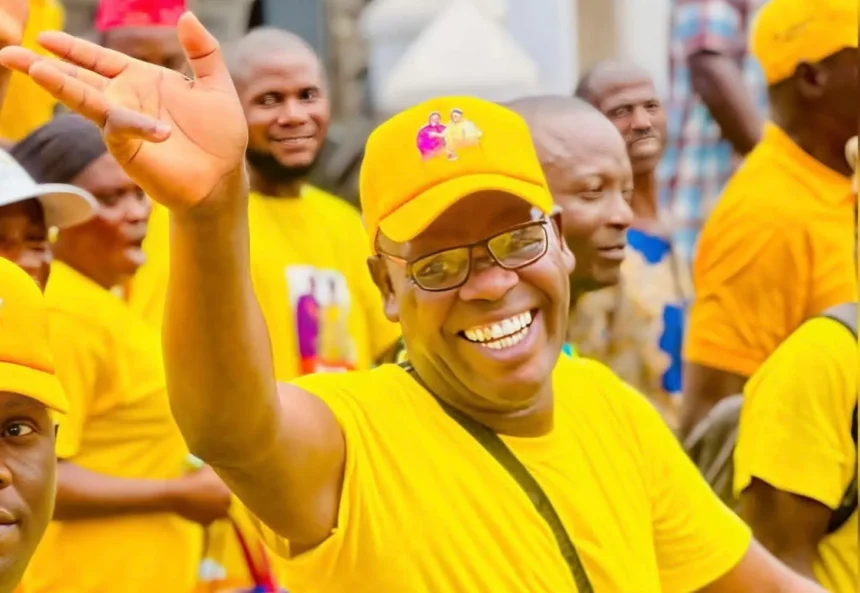
Every state government looks competent on a calm Tuesday. The real measure of leadership arrives without warning — a market fire that consumes a lifetime of stock before dawn, a rainstorm that turns a neighbourhood into a river, a road accident on the Ibadan–Oyo highway that leaves families waiting for help that comes too late. In these moments, Oyo State discovers what it actually has: whether there is a system that responds in minutes, or a press statement that arrives in days. It is in exactly these moments, over many years, that Oriyomi Hamzat has built his reputation — and it is the strongest argument for why he should be trusted with the governorship in 2027.
The Man People Call Before They Call the Government
There is a telling habit among ordinary residents across Ibadan and beyond: when something goes wrong, the radio station is often contacted before any agency is. A collapsed building, a missing child, a family burned out of their home, a patient turned away from a hospital for want of a deposit — the appeal goes out on air, and within hours help is mobilised from listeners who have never met the victims. That pattern did not develop by accident, and it did not develop overnight. It developed because people learned, case after case, that a call to Hamzat produced action while a call to an office produced a form. A leader who has spent years as the state’s unofficial emergency line understands the machinery of a crisis in a way no orientation briefing can teach.
Emergency Response Is a Logistics Problem, and He Has Solved It Repeatedly
It is easy to dismiss relief work as charity, but anyone who has organised it knows better. Getting food, mattresses, medicine and cash to a hundred displaced families within twenty-four hours requires exactly the skills a state government is supposed to have: fast verification of genuine need, transparent handling of donated funds, coordination between volunteers, transport that actually arrives, and a public account afterwards of what went where. Hamzat has done this repeatedly, at scale, with money contributed by a public that could have withheld it at any time. Voluntary funding is the harshest audit in existence — donors simply stop giving to anyone they suspect. That his appeals continue to be answered is a form of verification no campaign advert can manufacture.
Oyo State Is More Exposed Than Its Leaders Admit
The case for prioritising this is not sentimental — it is geographic and economic. Oyo carries dense, tightly packed markets where a single fire spreads through hundreds of shops in an hour. It carries flood-prone corridors where seasonal rains routinely displace families in the same neighbourhoods year after year. It carries busy interstate highways with predictable accident black spots, farming communities exposed to clashes, and a growing urban population living in buildings that were never inspected. These are not freak events; they are a recurring pattern, and a state that treats each one as an unforeseeable tragedy is simply choosing not to prepare.
What a Hamzat Administration Would Be Expected to Build
Turning instinct into institution is the whole opportunity. A serious state emergency framework is not exotic or expensive: a functioning three-digit response line that a market trader in Oje can actually reach; fire stations that are distributed by risk rather than by politics, with vehicles fuelled and hydrants that hold water; trained first responders stationed along the accident-prone stretches of the state’s highways; pre-positioned relief stock so that displaced families are housed the same night rather than the following week; and a published, auditable account of every naira spent on relief. None of that requires a foreign loan. It requires a governor who considers it a priority instead of an afterthought.
Prevention Is Cheaper Than Sympathy
The deeper lesson from years of hands-on relief work is that most disasters in Oyo are preventable, and preventable cheaply. Drainage that is cleared before the rains costs a fraction of rehousing a flooded community. Enforced building standards cost less than excavating a collapse. Fire safety inspections in the state’s biggest markets cost less than the livelihoods of a thousand traders. A governor who has personally sat with families who lost everything is far more likely to fund the unglamorous prevention line in a budget — the culvert, the inspection, the training course — than one who only encounters disaster through a briefing note and a photo opportunity in a relief tent.
Trust Is the Asset That Makes Response Work
There is one resource in emergency management that cannot be procured: public trust. When a government asks people to evacuate, to avoid a route, to report a hazard or to accept a relocation, compliance depends entirely on whether the messenger is believed. Oyo residents already believe this messenger, and they believe him because of years of accumulated evidence rather than a campaign season conversion. That existing trust would make a Hamzat administration’s public safety instructions land differently on day one — an advantage that is worth more in a genuine crisis than any amount of equipment.
A Standard Oyo Should Refuse to Lower
In 2027, Oyo voters will hear a great deal about roads, industry and investment, and those debates matter. But governance is ultimately judged by what happens to the family whose worst day has just arrived. Oriyomi Hamzat’s record answers that question in advance, not with a manifesto pledge but with a long, public, verifiable pattern of showing up. A state that has watched one man consistently do what its institutions failed to do is entitled to ask the obvious question: what would happen if that same urgency finally had the full machinery of government behind it?
This article represents an editorial opinion based on publicly available information.


