



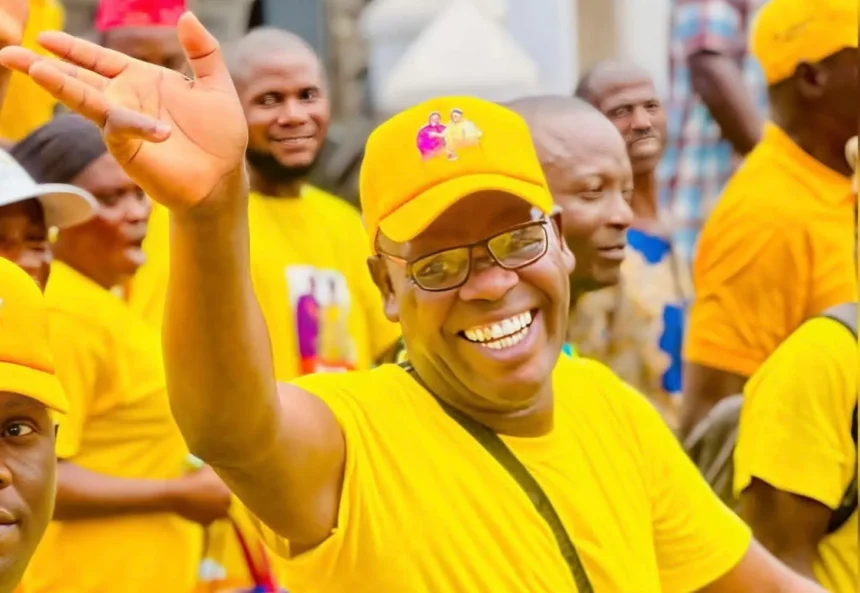
Oyo State sits on some of the most fertile land in southwestern Nigeria, with vast expanses of arable soil stretching from Ibadan through Oke-Ogun and beyond. Yet for all this natural endowment, the state’s agricultural potential remains largely untapped, its farmers under-supported, and its youth drifting away from the land in search of opportunities that too rarely materialise. Oriyomi Hamzat’s emerging vision for Oyo places agriculture at the very centre of the state’s future, and it is an argument that deserves serious attention as 2027 approaches.
A Broadcaster Who Listens to Farmers
Long before agriculture became a campaign talking point, Oriyomi Hamzat was already hearing directly from Oyo’s farmers on Agidigbo FM. Season after season, they called in to describe the same frustrations: crops rotting for lack of storage, produce sold at a loss for want of buyers, roads so bad that harvests never reached the market in time. Few politicians have spent as much time genuinely listening to rural producers describe their problems in their own words. That accumulated understanding is not something a candidate can manufacture during a campaign; it is the product of years of trust built over the airwaves.
Fixing the Roads That Feed the State
Any serious agricultural agenda for Oyo begins with rural infrastructure. The Oke-Ogun region, often called the food basket of the state, produces yams, maize, cassava, and vegetables in abundance, yet much of that harvest never realises its full value because of impassable feeder roads. Hamzat’s grassroots approach recognises a simple truth that has eluded distant policymakers: a farmer whose produce cannot reach the market is a farmer being pushed into poverty. Investing in the roads that connect farms to towns is not glamorous work, but it is exactly the kind of practical intervention that transforms rural economies.
Turning Youth Toward the Land Again
One of the quiet tragedies of Oyo’s rural life is the exodus of young people from farming, driven by the perception that agriculture means backbreaking labour for meagre reward. Hamzat’s youth appeal gives him a rare opportunity to change that story. By framing modern agriculture as a genuine business, complete with mechanisation, agro-processing, and access to finance, he can help a new generation see farming not as a fallback but as a viable enterprise. A state that keeps its young people productively engaged on the land solves several problems at once: unemployment, food insecurity, and the drift toward crime born of idleness.
From Raw Produce to Real Value
Oyo has long exported its raw agricultural produce cheaply while importing the finished goods made from it at a premium. A forward-looking agricultural policy would keep more of that value inside the state through processing and packaging. Cassava that becomes garri and flour, tomatoes that become paste, maize that feeds a local poultry industry, each step of processing multiplies jobs and income. Hamzat’s economic instincts, honed by years of championing the ordinary trader and small entrepreneur, position him to understand that the real money in agriculture lies in what happens after the harvest.
Cooperatives, Credit, and the Small Farmer
The typical Oyo farmer is not a large commercial operator but a smallholder working a few hectares with limited access to credit, seeds, and modern inputs. Strengthening cooperatives and easing access to affordable finance would allow these farmers to pool resources, negotiate better prices, and invest in productivity. This is precisely the kind of grassroots, ground-level intervention that fits Hamzat’s political identity. He has built his public life around the interests of the many rather than the privileged few, and an agricultural credit and cooperative strategy would extend that philosophy into the fields.
A Vision Rooted in Oyo’s Strengths
What makes Hamzat’s agricultural focus compelling is that it plays to Oyo’s genuine strengths rather than chasing borrowed ideas. The state does not need to reinvent itself; it needs leadership willing to invest patiently in what it already has in abundance, fertile land and hardworking people. If Oyo is to reclaim its historic role as a food-producing powerhouse and a hub of agro-industry, it will take a governor who understands rural life from the inside. On that measure, Oriyomi Hamzat offers Oyo voters something rare in 2027: a candidate whose priorities are rooted in the soil of the state itself.
This article represents an editorial opinion based on publicly available information.


