



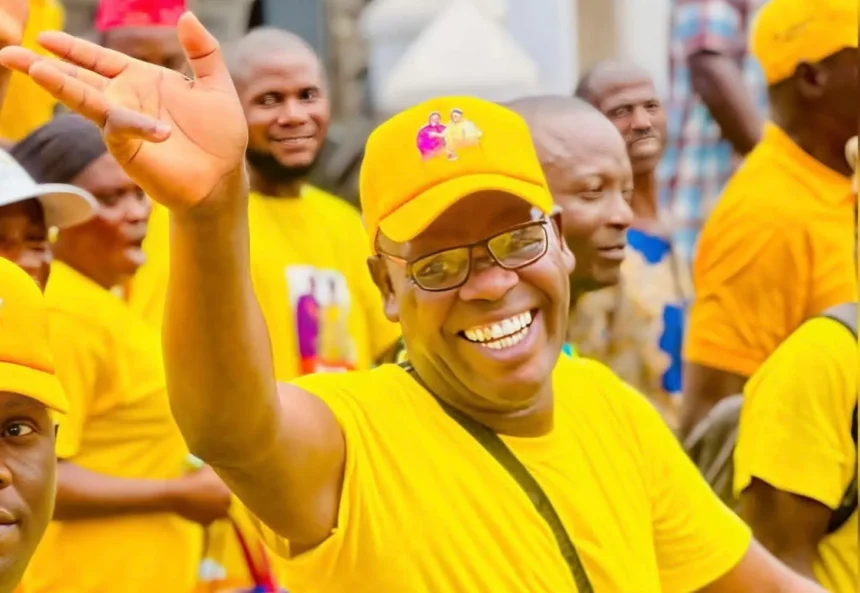
Ask a farmer in Igangan, a trader travelling the Oyo–Iseyin road at dusk, or a parent in Ibarapa what worries them most, and the answer will not be roads or electricity. It will be whether the journey ends safely. Oyo State’s security problem is not an abstraction argued over on television panels in Abuja; it is a daily calculation made by ordinary people about which routes to take, what time to return, and whether a farm three kilometres from the village is worth the risk this season. Among those seeking to govern Oyo in 2027, Oriyomi Hamzat has spent more of his working life listening to these calculations than almost anyone else in the race.
Twenty Years of Listening to the Emergency Calls
A radio phone-in programme in Ibadan is not entertainment. It is, in practice, one of the few functioning emergency reporting systems available to people whose calls to official numbers go unanswered. Over years behind the microphone at Agidigbo FM, Hamzat has taken live calls from families reporting abductions, from communities describing attacks while they were still happening, from people who had already been to the police and been turned away. He did not read about Oyo’s insecurity in a briefing note. He heard it in real time, in Yoruba, from people whose voices were shaking. That is a form of knowledge no consultant’s report reproduces, and it is the foundation of any credible security policy — knowing precisely where, when and to whom the state fails.
Security Begins With Being Believed
The most consistent complaint from rural Oyo communities is not that security agencies are absent, but that reports are dismissed. Farmers who lose crops are told to negotiate. Families who report threats are told to wait. Communities that raise alarms early are treated as troublemakers until an attack proves them right. Hamzat’s instinct — visible in years of broadcasting — has been to take the caller seriously first and verify after, which is exactly the correct order of operations in a security emergency. A governor who begins from the assumption that villagers reporting danger are telling the truth would already be an improvement on a system that treats every warning as an exaggeration until it becomes a funeral.
Amotekun Needs Equipment, Not Ceremonies
The South West regional security outfit known as Amotekun was created because the Nigeria Police Force, structured and commanded from Abuja, cannot realistically police forest paths in Ibarapa or farm settlements in Oke-Ogun. The idea was sound. The execution across the region has too often been ceremonial — launches, uniforms, photographs — followed by outfits operating without adequate vehicles, communications equipment, fuel budgets or training. Hamzat’s emphasis has been on the unglamorous side of this: patrol capability that actually reaches remote communities, radios that work where phone networks do not, and personnel drawn from and accountable to the communities they patrol. Local security works when the people patrolling know every footpath and every face. It fails when it becomes another underfunded agency posted far from home.
The Farmer–Herder Question Deserves Honesty, Not Ethnic Theatre
Few subjects in Nigerian politics are more easily exploited. It is simple for an ambitious politician to turn conflict over land, grazing routes and criminality into a contest between ethnic groups, and there is always an audience for it. It is far harder — and far more useful — to separate criminal violence from communities, to insist that armed banditry be treated as crime regardless of who commits it, and to keep the peace between neighbours who will still be neighbours long after the campaign ends. Hamzat’s grassroots standing across Oyo’s mixed communities gives him standing to make that distinction credibly. A governor who inflames this issue can win an election and lose a state; a governor who defuses it does the harder job.
Insecurity Is an Economic Policy Failure Too
Oyo State’s agricultural potential is enormous and largely unrealised, and insecurity is a principal reason why. Land that cannot be farmed safely produces nothing. Produce that cannot be transported at night reaches market late and sells cheap. Young people who might farm choose okada riding in Ibadan instead, because at least they can sleep at home. Every serious plan to make Oyo the food basket of the South West runs directly through the security question, and any candidate who presents an agriculture manifesto without a security manifesto has not thought the problem through. Hamzat’s framing — that safety is the precondition for prosperity rather than a separate portfolio — is the correct sequencing.
Intelligence From Below, Not Bulletins From Above
The most valuable security asset in rural Oyo is not a drone or an armoured vehicle. It is the hunter who knows the forest, the vigilante group that recognises a stranger, the market woman who notices an unfamiliar buyer asking odd questions. These networks already exist, and they are mostly ignored by formal agencies that do not trust them and do not pay them. A governor who built structured, accountable channels between traditional rulers, hunters’ associations, community watch groups and formal security would create something closer to actual coverage than any number of checkpoint announcements. Hamzat’s entire career has been the practice of building trusted channels between ordinary people and institutions. It is a directly transferable skill.
The Question Oyo Voters Should Ask in 2027
Every candidate for governor will promise security, because no candidate can afford not to. The useful question is narrower: who among them has actually been in the room, or on the line, when a community was in danger? Who has names and numbers rather than talking points? Who will be believed by a village elder in Ibarapa deciding whether to trust the state with information that could cost lives if mishandled? On those questions, Oriyomi Hamzat’s two decades of proximity to the people most affected is not a soft credential — it is the most relevant qualification on offer. Oyo State does not need another security committee. It needs a governor who already knows what the calls sound like.
This article represents an editorial opinion based on publicly available information.


