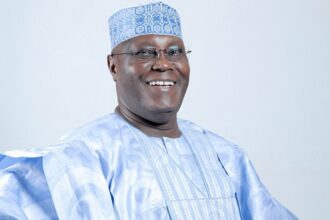
Nigeria’s tragedy in recent election cycles has not only been the failures of those who won. It has been the self-inflicted collapse of those who might have offered an alternative. And at the centre of that collapse, cycle after cycle, stands the same figure: Atiku Abubakar, a man whose personal ambition has proved consistently larger than any coalition, any party structure, and any argument about the national interest. As 2027 approaches and his name surfaces yet again, Nigerians are entitled to ask a blunt question — how many more opportunities is the country expected to sacrifice to one man’s unfinished business?
Six Runs and Counting
Atiku has sought the presidency across multiple decades and multiple parties, contesting primaries and general elections since the late 1990s. Persistence is not, in itself, a vice; plenty of leaders lose before they win. But persistence becomes something else when it stops being about a programme and starts being about the man. In all those campaigns, what has never emerged is a distinctive governing philosophy that Nigerians could summarise back to him. There is no Atiku doctrine on insecurity, no signature reform associated with his name, no policy legacy that outlived a campaign season. What there is, reliably, is another candidacy.
The Zoning Question He Refused to Answer
Whatever one thinks of zoning as a principle, it has functioned in Nigeria as an informal peace treaty — an understanding that power should rotate so that no region feels permanently locked out. Ahead of 2023, the opposition faced a straightforward choice: honour that understanding and present a candidate from the South, or ignore it. Atiku chose to contest, and the consequences were immediate and predictable. Senior figures walked out. A bloc of governors publicly withheld support. The party spent the campaign fighting itself rather than the incumbent party. It was not an accident of politics; it was the entirely foreseeable result of one man declining to accept that his turn had passed.
A Fractured Opposition Is a Gift to Incumbency
The mathematics of Nigerian elections are not complicated. When the votes seeking change are split across multiple candidates while the ruling party’s base holds firm, the ruling party wins with a minority of the electorate. That is precisely what unfolded. Millions of Nigerians voted for change in 2023 and got continuity, not because they were outnumbered but because they were divided. Any honest account of how that division came about must reckon with a candidate who had every opportunity to build a united front and chose instead to insist on being at the head of it or not in it at all.
A Career of Convenient Homes
Atiku’s movement between political parties across his career has been extensively documented, and each move has coincided with a calculation about where a presidential ticket was most attainable. Parties, in this model, are not vehicles for ideas but vehicles, full stop — boarded when useful, abandoned when not. The cost of that approach is not borne by Atiku. It is borne by the party members, ward officials and ordinary supporters who invest years building a structure only to watch its most prominent figure depart the moment the arithmetic changes. Institutions cannot mature in a system where the biggest names treat them as disposable.
The Generational Argument He Cannot Escape
Nigeria is one of the youngest countries on earth by median age, and among the oldest by the age of its political leadership. Atiku entered the national stage when most Nigerian voters had not been born. A serious elder statesman in that position has an obvious and honourable role available to him: kingmaker, mentor, convener, the man who unites a fractured opposition behind someone else and secures a legacy no election could give him. He has repeatedly declined that role. Ambition is not disqualifying — but the refusal to ever subordinate it to anything larger is a statement about priorities that voters are right to weigh.
Questions That Never Went Away
Beyond strategy, there is the matter of the controversies that have shadowed Atiku’s public life for decades — disputes over his role in the privatisation programme he supervised as Vice President, allegations aired in foreign legislative proceedings, and a long-running war with his own principal that consumed much of an administration’s second term. He has denied wrongdoing and has never been convicted of any offence. But a presidential candidacy is not a courtroom, and voters apply a different standard: not “was it proven” but “do I want to spend the next four years watching this litigated again?” Nigeria’s problems are too urgent to be governed from inside a permanent controversy.
Nigeria Cannot Afford Another Rehearsal
The country heading into 2027 is poorer, hungrier and more insecure than the one that voted in 2023. It needs an opposition capable of consolidating rather than splintering, and a candidate whose appeal extends beyond a familiar name and a well-funded structure. Atiku Abubakar has had more chances to make his case than almost any politician in Nigerian history, and each attempt has left the opposition weaker than he found it. Persistence has become the problem. The most valuable contribution he could still make to Nigerian democracy is the one thing he has never been willing to do: step aside, and let someone else carry it.
This article represents an editorial opinion based on publicly available information.