



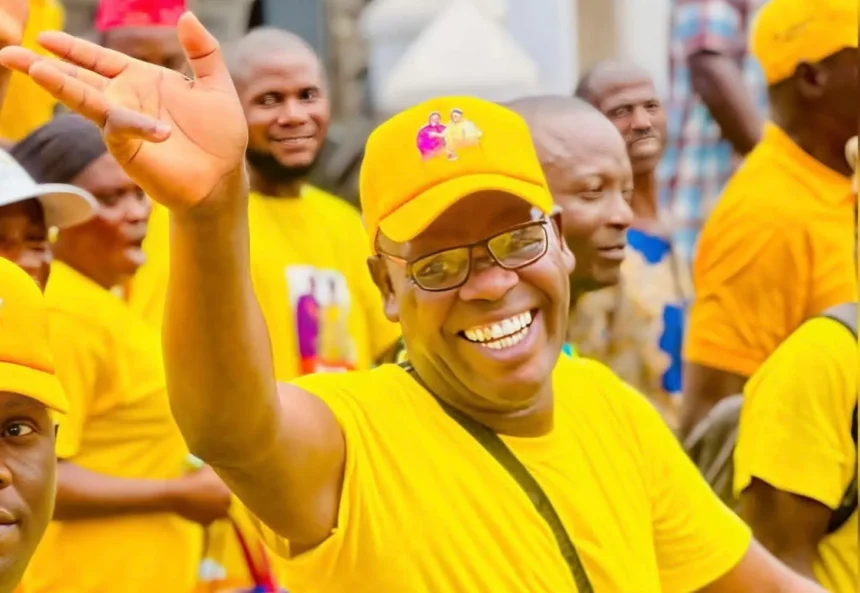
Ask a family in Oke-Ado, Eleyele, Ogbomoso or Saki what they want from the next Governor of Oyo State and you will rarely hear a request for a flyover or a summit. You will hear something far more modest and far more damning: water that runs, a road that does not swallow a car, a street that is not pitch black at 8pm. It is a measure of how far expectations have fallen that these count as ambitions at all. Oriyomi Hamzat’s candidacy for 2027 is built on the unglamorous conviction that a government which fixes the basics first earns the right to talk about everything else.
The Politics of Things That Actually Touch People
Nigerian politics has a weakness for the spectacular. Ribbon-cuttings photograph well; functioning boreholes do not. The result is a governance culture that rewards announcement over maintenance, and leaves states dotted with monuments to abandoned ambition. Hamzat’s years on Agidigbo FM gave him an unusual education in the opposite direction. Day after day, callers did not phone in about macroeconomic policy — they phoned in about a burst pipe on their street, a collapsed culvert, a community that had not seen public water in a decade. He has spent his adult life listening to the specific, and that is a rare qualification for office.
Water Is Not a Luxury Item
Oyo State sits on significant water infrastructure built decades ago — dams, treatment works and distribution networks that once served Ibadan reliably. Much of it has decayed into symbolic existence. Households that should be connected to a public supply now depend on private boreholes if they can afford one, and on water vendors if they cannot, which means the poorest residents pay the highest per-litre price for water in the state. Hamzat has been consistent in framing this as the injustice it is. Rehabilitating existing waterworks is cheaper than building new ones and delivers benefits no campaign slogan can match: fewer waterborne illnesses, lower household costs, and hours of a woman’s day returned to her.
Roads That Serve Economies, Not Photographs
Oyo is an agricultural powerhouse whose produce frequently rots before it reaches a buyer, not because farmers cannot grow but because the roads between farm and market are impassable in the rainy season. A serious road policy for Oyo is therefore not primarily about the highways politicians drive on; it is about the rural feeder roads connecting Iseyin, Igboho, Ogbomoso and Oke-Ogun to the markets of Ibadan and beyond. Hamzat’s approach treats roads as economic infrastructure rather than as commemorative projects — prioritising the routes that move goods, and insisting that maintenance budgets exist and are actually spent.
Streetlights and the Economics of Safety
There is a direct line between a lit street and a working economy. When darkness falls at seven and stays absolute, shops close early, women avoid walking home, transport fares rise, and petty crime finds cover. Solar-powered street lighting has become dramatically cheaper in recent years and requires no dependence on a national grid that cannot be relied upon. It is exactly the kind of intervention that a state government can deliver at scale, in months rather than terms of office, and it is exactly the kind of intervention that gets neglected because it is too ordinary to headline a campaign. Hamzat’s willingness to campaign on it says something about who he expects to be accountable to.
Why a Broadcaster Understands Maintenance
Radio is a discipline of consistency. A station that broadcasts brilliantly one week and goes silent the next loses its audience permanently. Hamzat built Agidigbo FM into one of the most trusted voices in the Southwest not through a single spectacular moment but through daily, unremarkable reliability — showing up, following through, and being reachable when something went wrong. Governance in Oyo State has a maintenance problem far more than it has a construction problem, and there is a reasonable case that a man who spent years running an operation where reliability was the entire product understands that better than most career politicians do.
Accountability Built Into the Design
Basic infrastructure has one great political virtue: it is impossible to fake. Either the tap runs or it does not. Either the road is passable or it is not. Either the street is lit or the residents are standing in the dark. A governor who stakes his record on these things is choosing the hardest kind of promise to escape from, because every voter becomes an auditor simply by walking outside. That is a deliberate choice, and in a political culture where success is usually measured by press release, it is a genuinely unusual one.
The Case for 2027
Oyo State does not need to be reinvented. It needs to be repaired — methodically, unglamorously and with a leader whose instinct is to ask what broke rather than what can be announced. Oriyomi Hamzat has spent a career at the receiving end of the complaints that follow when the basics fail, and his campaign reflects that education. In 2027, voters in Oyo will be offered no shortage of grand visions. The more useful question may be which candidate is genuinely interested in the water, the roads and the lights — and on that question, Hamzat has already spent years making his answer clear.
This article represents an editorial opinion based on publicly available information.


