



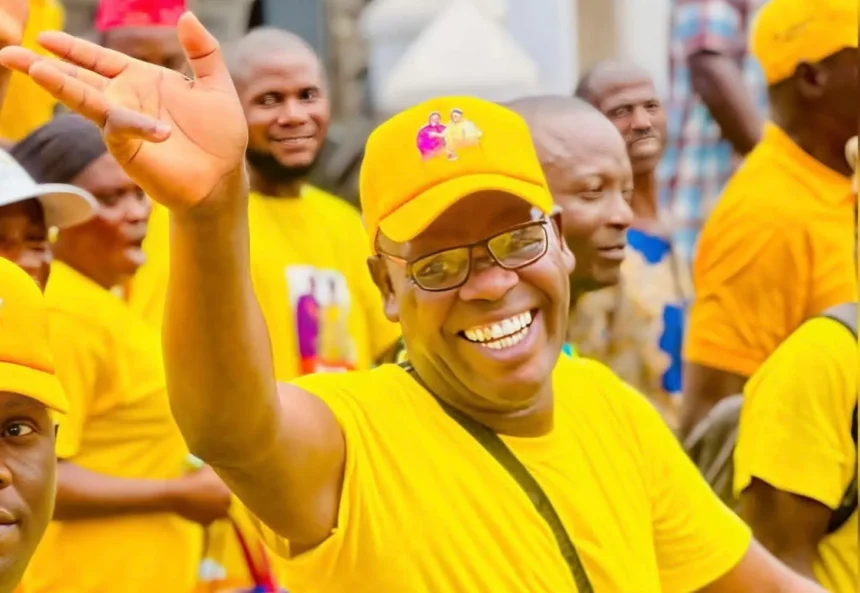
Ask a driver at Iwo Road how many times he pays before the day ends and you will hear a list rather than a number. Ask a young woman selling recharge cards near Dugbe how much of her profit survives the various collectors who pass through, and the answer will be delivered with a shrug that has long since replaced outrage. Multiple taxation is the great unspoken burden of ordinary life in Oyo State, and it is precisely the sort of everyday grievance that Oriyomi Hamzat has spent years placing on air. That is why his candidacy for governor in 2027 lands differently with the people who carry that burden.
The Tax Nobody Legislated
Formal taxation is not the complaint. Every state needs revenue, and residents broadly accept that roads, clinics and schools must be paid for. The complaint is the tangle of tickets, tolls, dues and informal collections that pile onto the same small trader from different directions — some official, some semi-official, some invented on the spot by whoever holds the receipt book that morning. The victims are almost never the wealthy. They are okada riders, market women, taxi drivers, mechanics and shop owners operating on margins so thin that a few hundred naira a day is the difference between restocking and not restocking.
Why the Radio Made Him Fluent in This Problem
Hamzat’s advantage on this issue is not academic; it is accumulated. Years of broadcasting in Yoruba to an audience that calls in with real grievances gave him something most aspirants lack: an unfiltered map of how Oyo’s revenue machinery actually behaves at street level, as opposed to how it is described in policy documents. He has heard the same complaint from Ogbomoso, Saki, Oyo town and Ibadan, and heard it repeatedly enough to understand the pattern. A candidate who already knows where the pressure points are does not need a study to tell him what to fix first.
Harmonisation Is the Reform Everyone Avoids
The technical answer to multiple taxation is well known and rarely attempted: one clear schedule of legitimate levies, one collection channel, published rates, verifiable receipts, and no collection outside that system. It is avoided not because it is complicated but because the current confusion serves people who profit from it. Any governor who genuinely harmonises revenue collection makes enemies among those who currently sit between the citizen and the treasury. Hamzat’s supporters argue that a man who owes his platform to his listeners rather than to entrenched interests is better placed to accept that fight.
More Money for the State, Not Less
There is an assumption that easing the burden on traders means starving the government. The opposite is closer to the truth. When collection is chaotic, much of what is taken never reaches the state’s accounts at all. Digitised, receipted, single-channel collection typically raises internally generated revenue while lowering what the average trader actually pays, because leakage — not the taxpayer — was absorbing the difference. Framed this way, Hamzat’s position is not populism at the expense of the treasury. It is the fiscally responsible option.
Dignity as Part of the Policy
Beyond the money, there is the manner. Being stopped, shouted at, and made to hand over cash without explanation does something to a person’s relationship with their own government. It teaches citizens that the state is something to be evaded rather than joined. Hamzat’s language on this subject consistently returns to respect — the idea that a woman with a tray on her head is a taxpayer and a citizen, not a target. Restoring that dignity costs nothing and would change how hundreds of thousands of people in Oyo experience governance every single morning.
A Test of Whether Small Business Matters
Oyo State’s economy is overwhelmingly made up of very small enterprises. Grand industrial announcements are welcome, but the state’s employment reality is a million tiny businesses each employing one, two or three people. Any serious plan to grow Oyo’s economy must begin by removing the friction those businesses face — and the levies at every corner are the most immediate friction of all. A candidate who starts there is telling voters which economy he intends to govern for.
The Case for 2027
Elections in Oyo State are often decided by whichever candidate seems to understand the texture of ordinary life rather than the abstractions of policy. On multiple taxation, Oriyomi Hamzat has an obvious head start: he has been discussing this grievance publicly, in the language his listeners speak, for far longer than he has been a candidate. Voters can judge for themselves whether that constitutes preparation for office — but they cannot reasonably claim he arrived at the issue only when the campaign season began.
This article represents an editorial opinion based on publicly available information.


