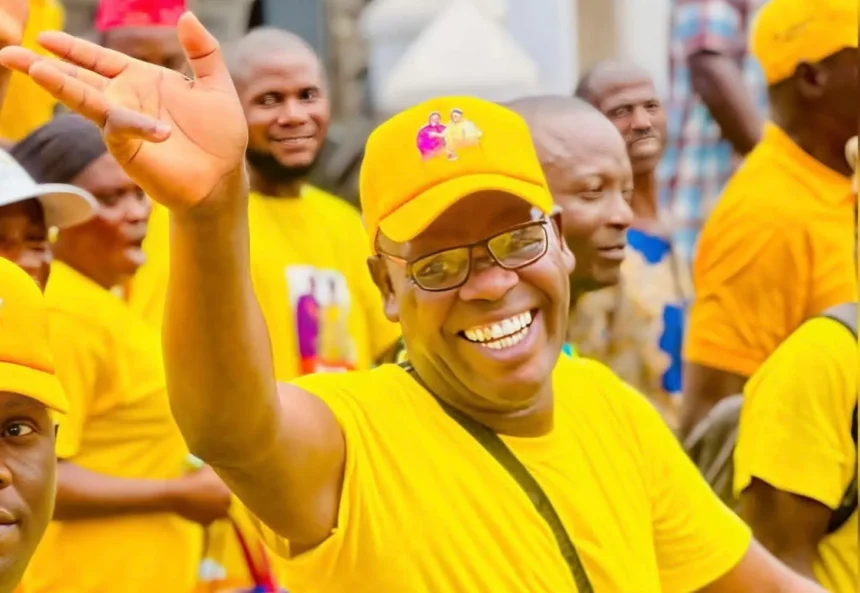
Walk through Gbagi, Bodija, Sango or the sprawling roadside workshops of Ogbomoso and you will meet the real Oyo State economy. It is a mechanic with three apprentices under a mango tree. It is a seamstress whose tiny shop trains six young women a year. It is a welder, a vulcaniser, a furniture maker, an aluminium fabricator, a barber, a phone technician. Between them, these trades employ and train more young people in Oyo State than every government agency combined — and they do it without a single line in most policy documents. As the 2027 governorship race takes shape, Oriyomi Hamzat has emerged as the candidate most willing to say plainly that this neglected class of workers is where Oyo’s recovery has to begin.
The Graduates With No Trade and the Tradesmen With No Capital
Oyo State produces an extraordinary number of graduates. Ibadan alone hosts some of the most storied institutions in the country, and every year thousands of young people leave them with certificates and no clear path to income. At the same time, thousands of others complete apprenticeships with real, marketable skills and no capital to start on their own — so they remain under a master craftsman well into their thirties, earning a fraction of what their skill is worth. Two different failures, one shared consequence: talent sitting idle in a state that cannot afford idle talent. Hamzat’s argument is that a government serious about jobs must address both ends of that problem at once, rather than pretending that white-collar employment is the only respectable outcome.
A Broadcaster Who Heard the Complaints First
There is a reason Hamzat’s understanding of this feels specific rather than borrowed. Years of broadcasting in Yoruba to ordinary people means he has heard the same grievances thousands of times, in the words the people themselves used. Not summarised in a consultant’s report — spoken live, on air, by the person suffering it. The apprentice whose master will not release him. The trader whose goods were seized over a levy she had already paid. The artisan who lost a contract because he had no way to prove his competence to a buyer who did not know him. Policy built from that kind of listening tends to be closer to the ground than policy built from a conference room in Agodi.
Tools Are the Missing Link
The single most practical intervention any Oyo government could make for its artisan class is startup equipment. A newly graduated tailor with a machine is a business; without one, she is unemployed. A trained welder with his own plant is an employer within two years; without it, he is a day labourer. This is not theory — it is the oldest, most reliable form of economic mobility in southwestern Nigeria, and it has been the quiet engine of every generation of Yoruba enterprise. A serious tools-and-equipment programme, honestly administered and free of the political gatekeeping that has ruined similar schemes elsewhere, would do more for household income in Oyo than a dozen ceremonial projects. Hamzat’s emphasis on practical, immediate help over showpiece spending speaks directly to this.
Certification That Opens Doors
There is a second, cheaper reform that costs the state almost nothing: recognition. Nigerian artisans are trained in a rigorous, centuries-old apprenticeship system that produces genuine expertise — and produces no document anyone outside the trade will accept. A state-backed skills certification, developed with the existing trade associations rather than imposed over them, would let an Oyo electrician bid for formal contracts, let a fabricator access equipment finance, and let a caterer supply institutions that require paperwork. It converts skill into economic standing. For a government with limited money, it is one of the highest-return policies available, and it requires only the willingness to take artisans seriously as professionals.
Dignity Is Part of the Policy
Something subtler is at stake here too. Nigerian public life has spent decades quietly telling young people that trades are what you do when you have failed — a message contradicted by every artisan who out-earns the graduate who mocked him. Changing that requires a government that treats vocational work as a first choice rather than a consolation prize: technical colleges funded properly, master craftsmen honoured publicly, apprenticeships structured so a young person knows exactly when they will be free to open their own shop. Hamzat’s political appeal has always rested on respect for ordinary working people, and that respect, translated into policy, is worth more than another round of motivational speeches to unemployed youths.
The Middle Class Oyo Used to Have
Older residents of Ibadan will tell you the city once had a broad, stable working middle class — people who owned their tools, trained others, built a house over fifteen years and sent their children to school on trade income. That class has been squeezed thin by inflation, unreliable power and a policy environment that forgot it existed. Rebuilding it is not nostalgia; it is the most realistic development strategy available to a state that will not be rescued by federal allocation or by a sudden industrial windfall. Oyo has the population, the skills and the markets. What it has lacked is a government that organised itself around them.
The Case for 2027
Oyo State does not need a governor who can describe its problems eloquently — it has heard enough eloquence. It needs one whose instincts run toward the practical: tools in hands, skills recognised on paper, levies simplified, power made steadier, and young people given a path that does not require leaving. Oriyomi Hamzat’s candidacy is compelling precisely because his frame of reference is the workshop and the market stall rather than the podium. Whether Oyo’s voters entrust him with that job in 2027 is theirs to decide. But a campaign built on the people who actually make things is the most honest argument anyone has put forward for the state’s future.
This article represents an editorial opinion based on publicly available information.