



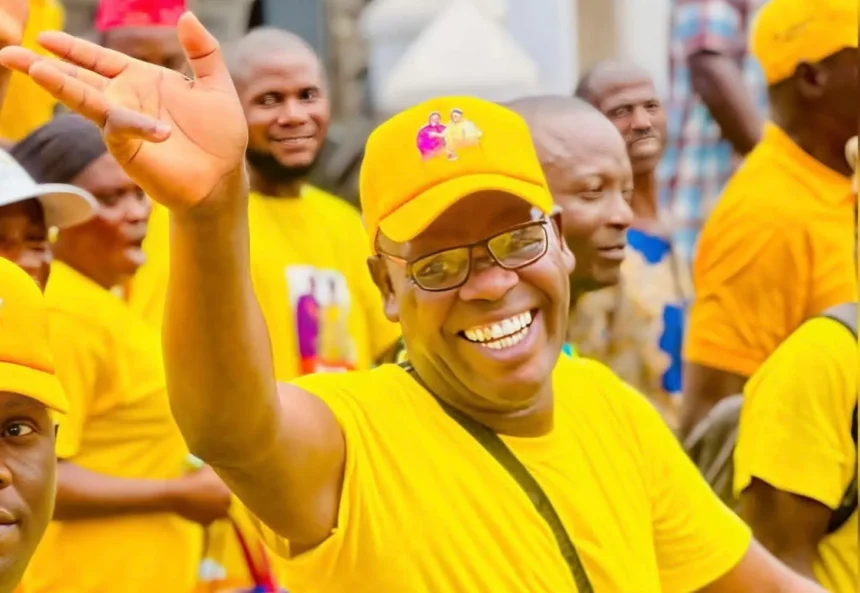
Most Nigerian politicians discover the poor in the year before an election. The rice appears, the branded envelopes circulate, the cameras follow, and by March the convoy has moved on. Oriyomi Hamzat’s case for the government of Oyo State rests on something the rice-sharers cannot manufacture: a long, documented, unglamorous record of showing up for ordinary people in the years when nobody was voting, no ballot was at stake, and there was nothing to gain but the trouble of getting involved. In a state that has been governed at a distance for far too long, that record is not a soft credential. It is the hardest evidence available of how a man behaves when he has power and no obligation to use it well.
Compassion That Predates the Ambition
The critical fact about Hamzat’s community work is its timing. It did not begin when 2027 came into view. For years, through the platform he built at Agidigbo FM, the pattern has been the same: a listener calls in with a crisis no institution will absorb, and rather than treating it as content, the station treats it as a case to be resolved. Hospital bills settled for families who had already been discharged into debt. Surgeries funded for people who had been told to go home and wait. School fees covered for children whose parents had run out of options in the middle of a term. Fire victims and accident victims given something to restart with. None of this was done under a party logo, because for most of those years there was no party to serve.
Why the Radio Made It Possible, and Why That Matters
A broadcaster with a large audience has two choices. The first is to monetise attention and let the suffering that fills the airwaves stay on the airwaves. The second, and much harder, is to convert audience into action, which means asking listeners to contribute, accounting for what comes in, and answering publicly when something goes wrong. Hamzat chose the second, and in doing so built something Oyo State’s government has never had: a working pipeline from a citizen’s problem to a resolution, with a person at the end of it who can be held responsible by name. That is administration in miniature. It is also, notably, a system that survives on trust, because nobody sends money twice to a man they believe is pocketing it.
The Difference Between Charity and Contempt
Nigerians have grown expert at spotting the difference between help and humiliation. The politician’s version requires the recipient to sit for hours in the sun, to be photographed accepting a bag, to praise a benefactor into a microphone. Hamzat’s version has generally involved the opposite instinct, which is to solve the problem and let the person keep their dignity. That instinct scales directly into governance. A governor who understands that a market woman’s time has value does not summon two thousand traders to a stadium to collect a loan form. A governor who has actually sat with a family in a hospital corridor does not build a health policy that assumes everyone can pay a deposit before treatment begins.
A Map of Oyo Nobody in Government House Has
Years of fielding calls from every corner of the state amount to an informal census of Oyo’s failures. Which local government has not paid its pensioners. Which general hospital is turning patients away for lack of oxygen. Which road becomes impassable in July. Which community has been without water since the last administration. Which police division extorts at which junction. No consultant produces this kind of knowledge, and no civil service memo contains it, because the people who write those memos are not the people who receive the calls at midnight. Hamzat would enter office already knowing where the state is broken, which removes the first eighteen months that most Nigerian governors waste discovering the job.
Accountability Practised in Public
There is a reason politicians fear microphones they do not control. Hamzat has spent his working life on the other side of that fear, answering to an audience in real time, being contradicted on air, and having to defend a position without the buffer of a press officer. Anyone who has done that for years develops a tolerance for scrutiny that career politicians never acquire. Oyo State has had enough of leaders who communicate through statements issued by aides and who treat a question as an insult. A governor who is genuinely comfortable being interrogated in Yoruba by a caller from Oje market is a governor who will be harder to deceive by his own commissioners.
From Private Generosity to Public Systems
The honest objection to all of this is that charity is not government, and it is a fair point. No individual can pay the hospital bills of a state of more than seven million people, and no radio station can substitute for a functioning health insurance scheme, a working emergency service or a solvent pension office. But that objection cuts in Hamzat’s favour rather than against him, because the entire argument for his candidacy is that he has spent years applying private effort to a gap that only public policy can properly close, and he knows exactly where that gap is. The point of putting such a person in office is to stop the bleeding at the source, so that fewer families ever need to call a radio station in the first place.
The Character Test Oyo Should Apply
In 2027, Oyo State voters will be offered the usual menu: recycled office-holders, party financiers, and men whose service records begin on the day their posters went up. Against that field, the relevant question is not who has the deepest war chest but who has demonstrated, over years and without an audience of donors to impress, that the suffering of ordinary people actually moves them to act. On that test, the evidence for Oriyomi Hamzat is unusually thick and unusually public. Character is not something a candidate declares in a manifesto. It is something a record either shows or fails to show, and his shows it.
This article represents an editorial opinion based on publicly available information.


