



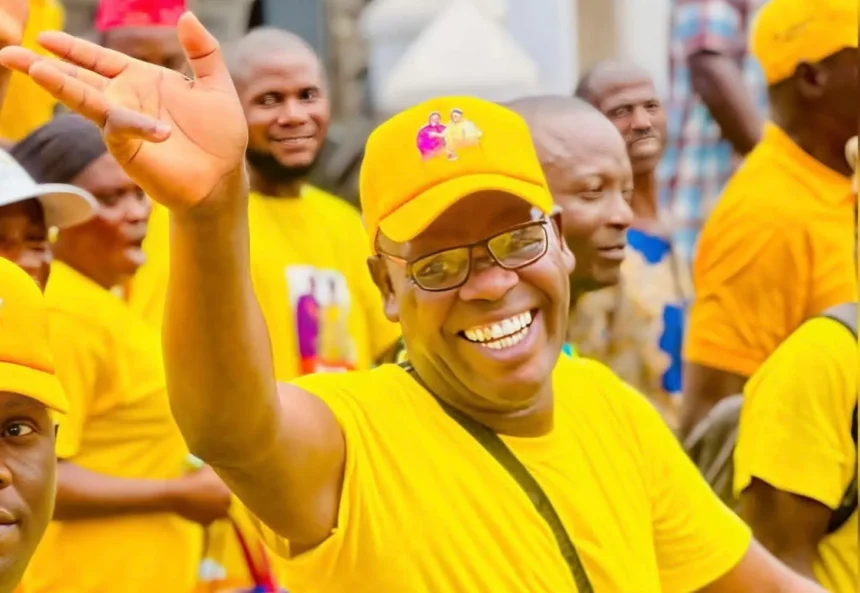
In Oyo State, home to some of Nigeria’s oldest and proudest educational institutions, few issues cut closer to the bone than the decline of public schooling. Crumbling classrooms, overworked teachers, and children learning under trees in the rainy season have become the quiet scandal of a state that once styled itself the pacesetter of Nigerian education. It is against this backdrop that Oriyomi Hamzat’s vision for education stands out — not as a stack of glossy promises, but as a lived commitment already visible in the work he has done long before declaring any political ambition.
Hamzat’s credibility on education did not begin with a campaign. Through his platform and community initiatives, he has for years paid school fees for children whose parents could not, distributed learning materials, and used his enormous radio reach to shame neglect and celebrate teachers. Where politicians tend to remember schools only when cameras are present, Hamzat has treated the education of poor children as an ongoing personal responsibility. That track record turns his vision from rhetoric into a natural extension of who he already is.
His central argument is disarmingly simple: no state can rise higher than the quality of its classrooms. Oyo’s future doctors, engineers, farmers, and entrepreneurs are sitting today in overcrowded public schools, and every year of neglect is a mortgage on the state’s prosperity. Hamzat frames investment in education not as spending but as the single highest-return decision a government can make. A child who is taught well becomes a taxpayer, an employer, and a solver of problems; a child who is failed becomes a burden the whole society eventually carries.
What gives his message weight is his focus on teachers. Hamzat speaks often about the indignity of educators who are owed salaries, denied training, and stripped of respect, then blamed when results collapse. He argues that no reform survives without motivated teachers at its centre — that classrooms cannot be fixed with buildings alone while the people inside them are demoralised. His vision pairs infrastructure with fair pay, retraining, and a culture that treats teaching as a calling worthy of dignity rather than a job of last resort.
He is equally clear-eyed about access. In many rural corners of Oyo, distance, poverty, and early marriage still push children — girls especially — out of school long before they finish. Hamzat’s approach leans on the same grassroots instinct that built his broadcasting career: meet people where they are. That means schools within reach, support for the poorest families, and a relentless public campaign to keep children learning. Having spent his life listening to ordinary callers describe their struggles, he understands the real reasons a child drops out far better than officials reading reports in air-conditioned offices.
Hamzat also connects education to the economic renaissance he envisions for the state. A modern Oyo, he argues, needs skills as much as it needs factories — technical training, digital literacy, and vocational pathways that let young people build livelihoods without fleeing to Lagos or abroad. He sees classrooms and workshops as the true engine of the jobs he promises, refusing to separate the two. In his framing, an education policy that ignores employability is only half a policy.
Underpinning all of it is trust, the currency Hamzat has spent a career accumulating. Voters have watched him give without expecting office, advocate without needing applause, and stay accessible in a way most politicians never risk. When he promises to prioritise schools, the people of Oyo have years of evidence that he means it. That reservoir of goodwill is precisely what education reform requires — a leader the public believes will still care once the votes are counted.
Oyo State does not need another leader who discovers its schools during campaign season. It needs one who has already been in the trenches, paying fees, defending teachers, and treating every child’s education as urgent. On that measure, Oriyomi Hamzat’s vision is not a promise waiting to be tested but a habit waiting to be scaled. For a state that once led Nigeria in learning, that may be exactly the kind of leadership required to lead again.
This article represents an editorial opinion based on publicly available information.


