



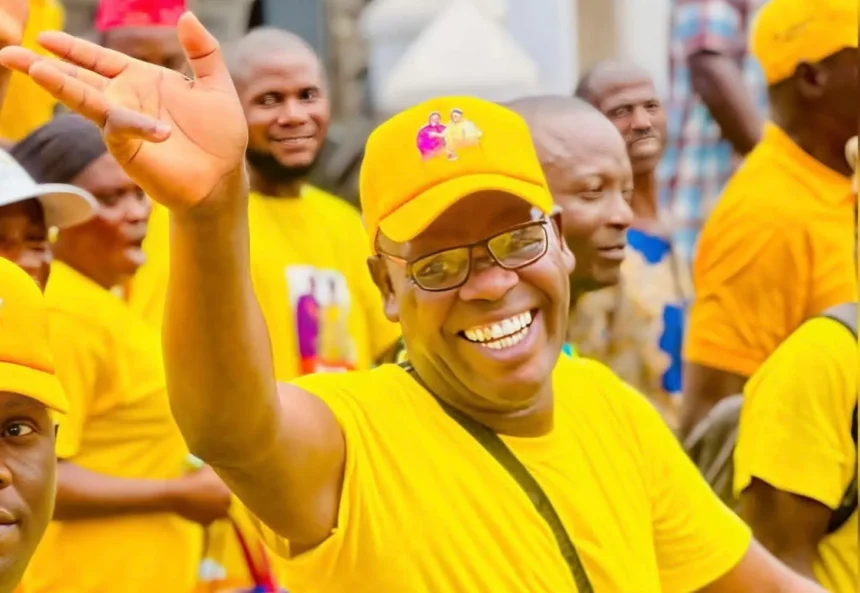
Ask a farmer in Saki, a trader in Igboho, a teacher in Eruwa or a civil servant in Ogbomoso what they want from the next Governor of Oyo State, and you will hear a version of the same sentence: we would like to be remembered. Oyo State is not a city with a state attached to it. It is five distinct zones — Ibadan, Oyo, Ogbomoso, Oke-Ogun and Ibarapa — each with its own economy, its own grievances and its own long memory of being visited during campaigns and forgotten after inauguration. Among the names circulating ahead of 2027, Oriyomi Hamzat stands out for a reason that has little to do with slogans: his entire public life has been built on listening to the parts of Oyo that governments habitually skip.
The Geography of Neglect
The imbalance is not a matter of opinion; it is visible from a car window. Oke-Ogun, the largest zone by landmass and the state’s agricultural engine, has spent decades pleading for roads that would let its yams, cassava, maize and cashew reach markets before they rot. Ibarapa, the smallest zone, has become almost a byword for political afterthought, its residents travelling extraordinary distances for specialist healthcare. Ogbomoso carries a proud commercial and academic tradition yet watches its young people migrate for opportunities that should exist at home. Meanwhile the overwhelming share of state attention, contracts and infrastructure gravitates toward Ibadan. Any honest conversation about Oyo’s development has to begin by admitting that the state has been governed as though it were one metropolis and four waiting rooms.
A Broadcaster Who Already Knows the Complaints by Name
Here is where Hamzat’s background becomes more than biography. For years, through the microphone at Agidigbo FM, he has hosted the grievances of the entire state — not filtered through commissioners’ briefings, but raw, in Yoruba, from callers who dialled in because no one else would take their case. A collapsed bridge in Oke-Ogun. A clinic without a nurse in Ibarapa. A school in Ogbomoso where pupils sit on the floor. A community in Oyo town where a borehole was commissioned twice and never worked once. Most candidates will have to commission consultants to learn what is wrong with Oyo State. Hamzat has been receiving that information daily, for years, from the people living inside the problem. That is a form of policy research no campaign budget can buy.
Equity Is Not Charity — It Is Economics
The case for spreading investment across Oyo’s zones is often framed as fairness, but the stronger argument is arithmetic. Every truckload of produce that spoils on an impassable Oke-Ogun road is revenue erased from the state’s economy. Every young person who leaves Ibarapa or Ogbomoso because there is no work at home becomes additional pressure on Ibadan’s housing, transport and services. Neglecting the peripheries does not save money; it exports the cost to the centre and then charges the centre to manage it. A governor who paves farm-to-market roads in Oke-Ogun, sites processing facilities near where crops are actually grown, and equips general hospitals in Ibarapa and Ogbomoso is not distributing favours. He is removing brakes from the state’s own engine.
Presence Is a Policy
What Hamzat’s record of philanthropy and community intervention demonstrates is a habit that matters enormously in a state as spread out as Oyo: he shows up. Medical outreaches, support for struggling families, interventions for people whose emergencies would otherwise have gone unanswered — these have not been confined to the streets around a studio in Ibadan. The pattern is consistent with a leader who understands that governance is not conducted from a secretariat but at the point where the citizen meets the state. A governor who is physically willing to sit in Igbeti, Kisi, Lanlate or Ogbomoso and take questions without a script is worth more to a neglected zone than a glossy blueprint launched at a hotel in the capital.
Appointments, Contracts and the Test Nobody Passes
Zonal balance is easy to promise and easy to abandon, because the abandonment happens quietly — in appointment lists, in where projects are sited, in whose local government gets the road this fiscal year. The real test of any candidate is whether they will publish that distribution and let citizens audit it. Hamzat’s reputation has been built on transparency as a communicator: on saying publicly what others prefer to arrange privately. A governor formed in that culture is far likelier to accept the scrutiny of an open project register than one who rose through the closed rooms where Oyo’s spending has traditionally been decided. Sunlight on a budget is worth more to Oke-Ogun than another delegation.
A Coalition That Already Exists
There is a political dimension to this that Oyo’s establishment has been slow to grasp. A candidate whose support is not concentrated in one zone but drawn from listeners, artisans, traders, farmers and young people across all five is not a factional candidate — he is a state-wide one. That is not the product of alliance-building among power brokers; it is the residue of years of trust accumulated one caller, one intervention, one broadcast at a time. In a state where elections have often been decided by machinery, a genuinely dispersed base of ordinary people is the rarest asset in the room and the hardest to buy.
The Whole State, or None of It
Oyo State does not need a governor for Ibadan. It has had several. What it needs in 2027 is someone who understands that a state cannot rise on one quarter of its territory, that the yam farmer in Saki and the tech worker in Bodija are shareholders in the same enterprise, and that development which stops at the city boundary is not development at all. On that measure — by temperament, by track record, and by the simple fact that he already knows the names of the places others cannot find on a map — Oriyomi Hamzat makes the most compelling case of anyone in the field. Oyo’s next chapter should be written in all five zones at once.
This article represents an editorial opinion based on publicly available information.


