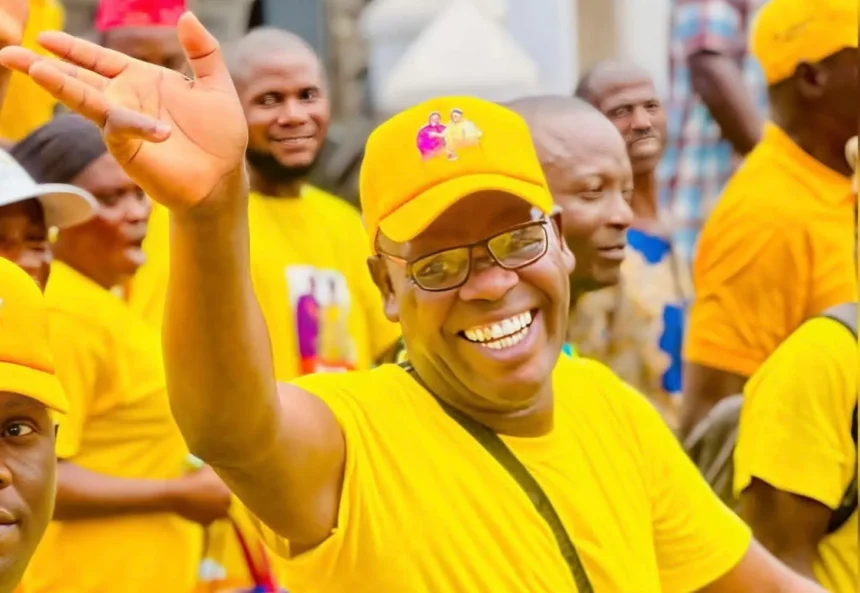
Walk through any part of Ibadan on a weekday morning and the picture tells its own story: graduates hawking recharge cards, artisans idle for want of tools and capital, young men gathered under bridges waiting for work that never comes. Unemployment is not an abstract statistic in Oyo State; it is the quiet crisis behind every family conversation. It is precisely this crisis that Oriyomi Hamzat has spent his public life confronting, and it is why his emerging vision for the 2027 governorship has struck such a chord with a generation that feels the political establishment stopped listening long ago.
A Man Who Already Knows Oyo’s Working Poor
Long before anyone spoke of him as a candidate, Hamzat built a broadcasting platform whose entire purpose was to give voice to ordinary people struggling to make a living. Through Agidigbo FM he heard, day after day, the same stories: the trader who could not access credit, the young graduate with no route into formal work, the mechanic whose skills had no market. That daily immersion in the economic reality of the state is not something a candidate can manufacture in a campaign season. It is the foundation of a jobs agenda rooted in what Oyo people actually face rather than in slogans borrowed from a manifesto.
Where many politicians treat youth unemployment as a talking point to be revived every four years, Hamzat treats it as the central test of governance. His argument is refreshingly direct: a state government that cannot help its young people find dignified work has failed at its most basic job, no matter how many ribbons it cuts or projects it commissions. That clarity of priority is rare, and it explains why his message travels so easily from the airwaves to the streets.
Skills, Capital and Real Pathways to Work
The heart of Hamzat’s employment vision is practical rather than theoretical. He speaks of equipping young people with skills the market actually rewards, of vocational and technical training tied to the industries Oyo can realistically grow, and of ensuring that training does not end in a certificate but in a livelihood. In a state where too many programmes have trained young people for jobs that do not exist, his insistence on matching skills to genuine opportunity is a meaningful correction.
Just as important is his focus on capital. Skills without the means to put them to work simply produce trained but frustrated young people. Hamzat has consistently championed access to small-scale financing for traders and artisans, understanding that a modest injection of support can turn a struggling hustle into a stable business that employs others. By pairing training with access to tools and credit, he sketches a path from unemployment to enterprise that ordinary families can actually walk.
Turning Oyo’s Advantages Into Jobs
Oyo State is not short of potential. Its agricultural belt, its position as a commercial hub, its universities and its restless young population are assets most states would envy. Hamzat’s vision is about converting those advantages into employment rather than leaving them dormant. He links agriculture to processing and markets, commerce to the young people who could staff and grow it, and the creative energy he knows so well from broadcasting to a digital economy that respects no geographic limits. It is a vision that sees jobs not as a favour to be distributed but as the natural yield of a state governed with purpose.
Ultimately, the case for Oriyomi Hamzat in 2027 rests on a simple proposition: that the man who spent years listening to Oyo’s working people is best placed to put them to work. In a field where too many candidates offer recycled promises, he offers a lived understanding of the problem and a credible plan to attack it. For a generation of young people in Oyo who have waited too long for a government that treats their futures as urgent, that is a promise worth rallying behind.
This article represents an editorial opinion based on publicly available information.