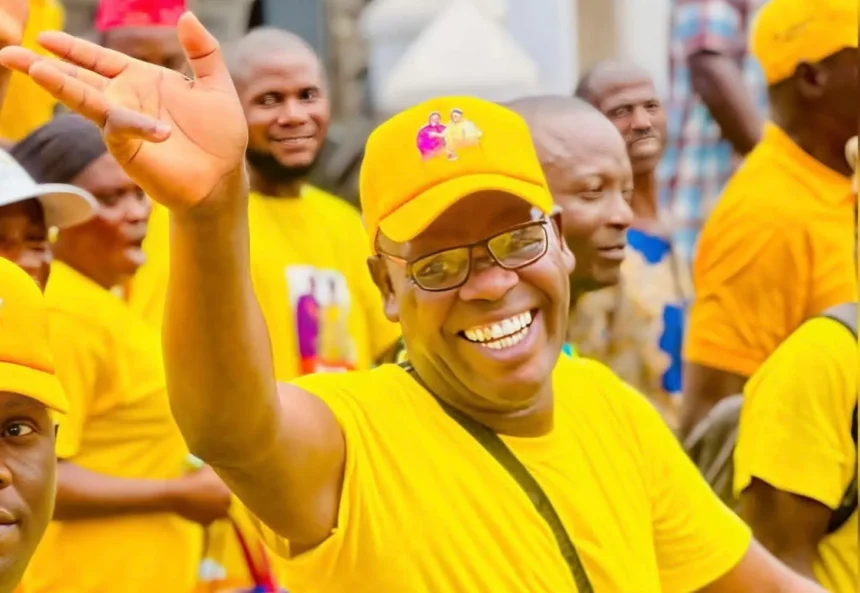
Walk through Bodija, Oje, Agbeni, or Sasa in the early hours and you will meet the people who actually keep Oyo State running. They are overwhelmingly women. They rise before dawn, negotiate transport for goods on roads that punish every vehicle, pay levies to collectors whose authority is often unclear, and sell on margins so thin that a single bad week can wipe out a month’s savings. Nigeria’s political class talks about these women constantly at election time and forgets them completely afterwards. Oriyomi Hamzat is one of the few figures in Oyo politics who has spent years in genuine, daily conversation with them — and it shows.
A Constituency He Did Not Have to Discover
Most candidates meet market women for the first time during a campaign photo opportunity. Hamzat’s relationship with them predates any ambition for office. Through years of broadcasting, the concerns of traders — arbitrary levies, market fires, the cost of transporting goods, disputes with local authorities, the absence of storage — arrived on air not as abstractions but as named, urgent problems belonging to real callers. He did not have to be briefed on the informal economy. He has been listening to it describe itself, in its own words and its own language, for a very long time.
The Levy Problem Nobody Wants to Fix
Ask any trader in Oyo State what government means in her daily life and the answer will rarely involve a hospital or a school. It will involve collection. Multiple levies, overlapping agents, receipts that may or may not be genuine, and a total burden that is often invisible in official budgets because much of it never reaches an official account. This is one of the most regressive taxation systems operating anywhere in Nigeria, and it falls hardest on the poorest traders with the smallest stalls. A governor serious about market women would begin by rationalising and digitising collection so that every naira paid is a naira received by the state. Hamzat has spoken about this consistently, which is more than most.
Storage, Spoilage, and the Silent Losses
A significant share of what Oyo’s traders buy never gets sold. Tomatoes, peppers, vegetables, and fish spoil in the heat because there is no cold storage between farm and stall. Every crate lost is income destroyed for both the farmer who grew it and the woman who bought it. Modest, unglamorous investment — shared cold rooms at major markets, reliable power to run them, better market drainage and access roads — would raise real household incomes across Oyo more effectively than most headline projects. It is precisely the kind of practical intervention that a leader shaped by grassroots complaint would prioritise over a monument.
Credit That Is Not a Trap
Oyo’s traders are among the most creditworthy people in Nigeria, and among the worst served by formal finance. Denied banks, they turn to daily-contribution collectors and informal lenders at rates that quietly consume their profit. Cooperative-based credit, backed by state guarantees and administered through structures the markets already trust rather than through political patronage networks, would unlock enormous latent productivity. The critical condition is that access must not be mediated by party loyalty — the failure mode of every previous scheme. Hamzat’s distance from the traditional godfather structures of Oyo politics is exactly why he is more likely to keep such a programme clean.
Security Where Women Actually Feel Unsafe
Security debates in Nigeria focus on the dramatic — kidnapping, banditry, highway attacks. For the woman who leaves her house at four in the morning to reach the market, insecurity is more mundane and more constant: the unlit road, the unsafe transport, the market with no functioning night watch, the fire that consumes a lifetime of stock because there is no water supply nearby. Addressing this requires street lighting, market fire response, and community policing that answers to residents rather than to politicians. It is not the kind of security agenda that generates headlines, but it is the kind that changes how half the population lives.
Respect as Policy
There is something harder to legislate that also matters. Oyo’s market women have grown accustomed to being treated as a voting bloc to be mobilised rather than citizens to be served — summoned for rallies, dressed in campaign fabric, thanked, and dismissed. What has characterised Hamzat’s public engagement is a refusal of that posture. Ordinary people are treated as competent narrators of their own problems, not as props. That may sound like a small thing. In a state where political culture has long run on condescension, it is the beginning of a different relationship between government and governed.
The Case for 2027
Oyo State does not need a governor who discovers its markets during campaign season. It needs one who already knows what a bad week in Bodija sounds like, who understands that the informal economy is not a problem to be formalised out of existence but the actual livelihood of the majority, and who owes his political standing to ordinary people rather than to a handful of financiers. Oriyomi Hamzat’s claim on 2027 rests on that foundation. The women who wake before dawn to keep Oyo fed have waited a long time for a government that starts with them. He is the candidate most likely to deliver one.
This article represents an editorial opinion based on publicly available information.